

On this page
Trailer sizing goes wrong in two directions. Buy too small and you make two trips or overload an axle. Buy too big and you paid for deck you tow empty, with a trailer your vehicle strains against. The right size comes from three numbers and one honest question.
Explore Rugged’s aluminum utility trailers, aluminum tilt trailers, aluminum deckover trailers, and aluminum enclosed trailers to compare sizes, published specifications, and current prices.
The three numbers that matter
- **GVWR** (Gross Vehicle Weight Rating): the maximum the trailer plus everything on it may weigh. This is a hard engineering limit, not a suggestion.
- **Payload**: GVWR minus the trailer’s own curb weight — what you can actually put on the deck. This is where aluminum quietly wins: a lighter trailer converts more of its GVWR into cargo.
- **GAWR** (Gross Axle Weight Rating): the per-axle limit. Tandem-axle trailers split load across two axles, which is why they jump from 2,990 to 7,000 lb GVWR in our line.
Your tow vehicle adds a fourth number — its tow rating — which caps everything. Trailer curb weight plus cargo must sit comfortably under it. Work through that side in how much can I tow?
The honest sizing question
What do you haul MONTHLY — not the once-a-year sofa move? Size for the recurring load, and rent for the exception. Most homeowners hauling a mower, ATV, or dump runs are genuinely served by a 5x8 to 6x12 single axle. For comparison, the current 6x10 utility has a nominal 72×120-inch deck and 2,398 lb estimated base payload; the 6.5x14 tandem steps up to a nominal 78×168-inch deck and 5,911 lb. Powersports depends on the exact machine — that is what the fitment guides are for.
Sizing by vehicle class
| Tow vehicle | Comfortable Rugged sizes | Typical loads |
|---|---|---|
| Compact / mid-size SUV | 5x8, 5x10, 6x10 single axle | Yard gear, snowblower, small ATV, dump runs |
| Large SUV | 6x12, 6x14, 6.5x12–6.5x14 | UTV, mower, household projects |
| Half-ton pickup | 6.5x14–6.5x18 tandem, tilt models | Side-by-sides, materials, equipment |
| HD pickup (3/4-ton+) | 6.5x18 tandem, tilt, 8x20 deckover | Machinery, multi-vehicle, commercial |
The current lineup with real numbers
| Size | Axles | Curb weight | Payload | Starting at |
|---|---|---|---|---|
| 5' x 8' | Single | 471 lb | 2,519 lb | $3,596 |
| 5' x 10' | Single | 493 lb | 2,497 lb | $3,926 |
| 6' x 10' | Single | 592 lb | 2,398 lb | $3,417 |
| 6' x 12' | Single | 670 lb | 2,320 lb | $3,777 |
| 6' x 14' | Single | 751 lb | 2,239 lb | $4,447 |
| 6.5' x 12' | Single | 714 lb | 2,276 lb | $3,999 |
| 6.5' x 14' | Single | 927 lb | 2,063 lb | $4,549 |
| 6.5' x 12' | Tandem | 1,023 lb | 5,977 lb | $6,999 |
| 6.5' x 14' | Tandem | 1,089 lb | 5,911 lb | $7,299 |
| 6.5' x 16' | Tandem | 1,130 lb | 5,870 lb | $7,599 |
| 6.5' x 18' | Tandem | 1,170 lb | 5,830 lb | $7,879 |
Note the pattern in the payload column: because the structures are aluminum, even the longest single-axle models keep over 2,000 lb of usable payload under the same 2,990 lb GVWR. A comparable steel deck gives several hundred pounds of that back to the trailer itself.
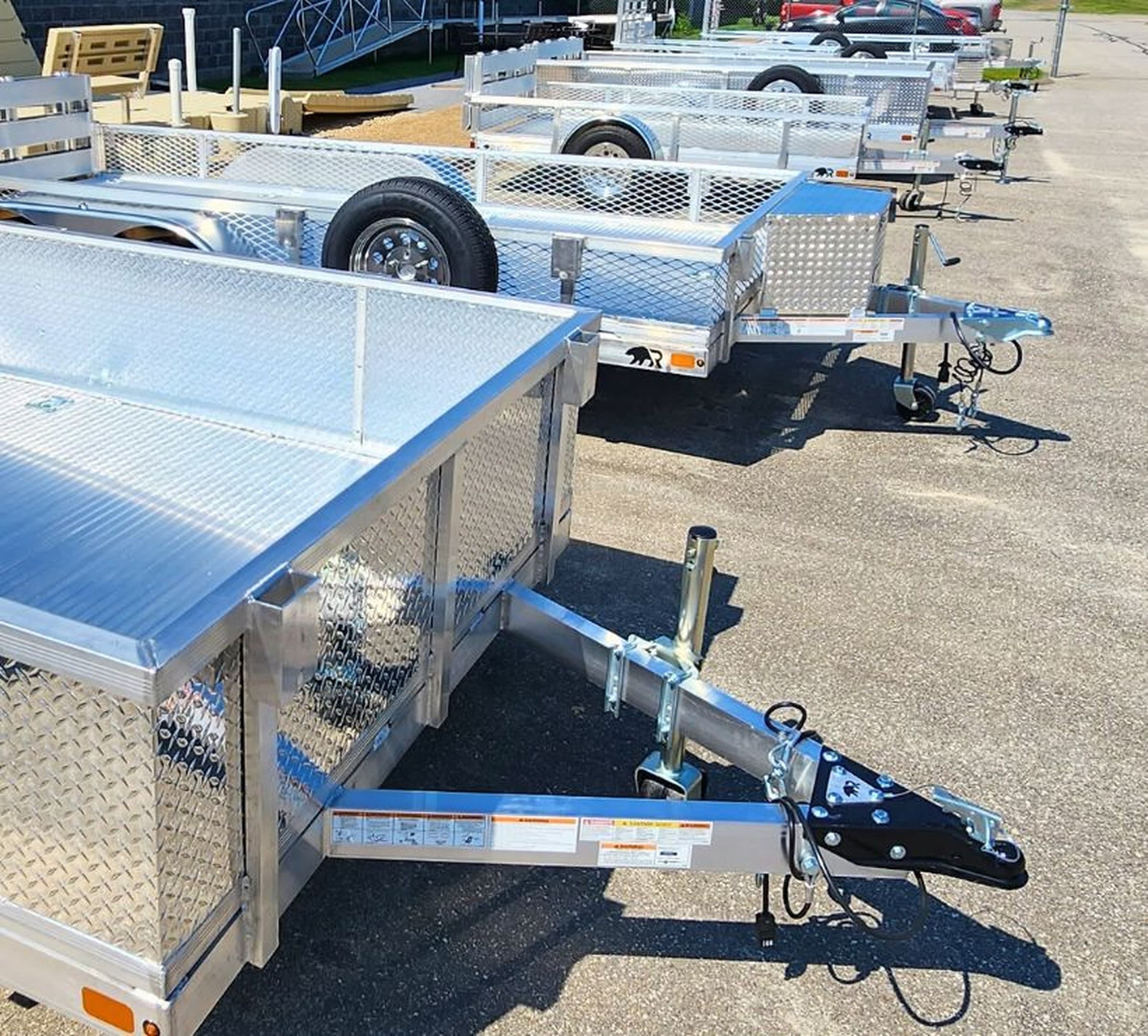
Single vs. tandem axle
Choose tandem when your recurring load exceeds roughly 2,000 lb, when you carry machines (the second axle adds stability and a blown-tire safety margin at highway speed), or when brakes matter — our tandem models carry electric brakes. Choose single for lighter duty: it is lighter, cheaper, and easier to move by hand.
- Is a bigger trailer always safer?
- No. An oversized, lightly loaded trailer can bounce and wander, and a trailer that pushes your vehicle’s tow rating is less safe than a smaller one well within it. Match the size to the load and the vehicle.
- What width do I need?
- The jump from 5 ft to 6.5 ft matters most for machines: side-by-sides and zero-turn mowers commonly need the 6.5 ft deck. Check the exact machine in the fitment guides before assuming.
- How much tongue weight should I plan for?
- Rule of thumb is 10–15% of loaded trailer weight on the hitch. Your vehicle’s door-jamb sticker lists its tongue-weight limit — heavier cargo forward of the axle raises tongue weight.