

On this page
If you are choosing between an aluminum trailer and a steel one, you have probably read a dozen pages that declare one material "the winner." This is not that page. We build aluminum trailers, so you know where we land — but the comparison only helps you if it is honest about where steel is genuinely better, and about the parts of our own trailers that are steel on purpose.
Explore Rugged’s aluminum utility trailers, aluminum tilt trailers, aluminum deckover trailers, and aluminum enclosed trailers to compare sizes, published specifications, and current prices.
The short version
- Steel is stronger per dollar and easier to repair anywhere. If your trailer will be dragged across demolition sites and repaired with a stick welder behind a barn, steel is a rational choice.
- Aluminum is roughly a third lighter for a comparable structure, does not rust, and holds resale value dramatically better — but it costs more up front.
- Over 10 years of real ownership — maintenance, fuel, resale — the total cost usually favors aluminum for anyone who keeps a trailer more than a few seasons. The math is below.
Durability: two different failure modes
Steel fails by corrosion. It is enormously strong when new, but the moment paint chips or a weld traps moisture, oxidation starts — and in the Northeast, where road salt sits on every winter mile, frame rot is the reason most steel trailers get scrapped. You do not wear out a steel trailer; you rust it out.
Aluminum can fail by fatigue when a structure is under-designed. Its natural oxide layer helps protect the surface, so it avoids the steel-frame rust that ends the working life of many conventional trailers. The honest caveat: aluminum is corrosion-resistant, not corrosion-proof (salt spray can still cause cosmetic pitting), and a badly engineered aluminum frame can crack at stress points steel would tolerate. That is why we use tubular extrusions rather than thin channel, and why the welds on our frames are among the first details we show you.
Weight: where the towing math changes
This is the difference you feel every time you hook up. A comparable steel single-axle utility trailer typically weighs 40–70% more than its aluminum equivalent. Our lightest utility model weighs 471 lb at the curb — light enough that a mid-size SUV tows it without noticing, and light enough that most of the 2,990 lb GVWR is usable payload rather than trailer.
Every pound the trailer does not weigh is a pound of cargo you can carry, or a pound of margin under your vehicle’s tow rating. For SUV owners this is often the whole decision: the aluminum trailer fits under the rating with room to spare; the steel one does not. Work through your own numbers in what your vehicle can tow.
Maintenance: the decade view
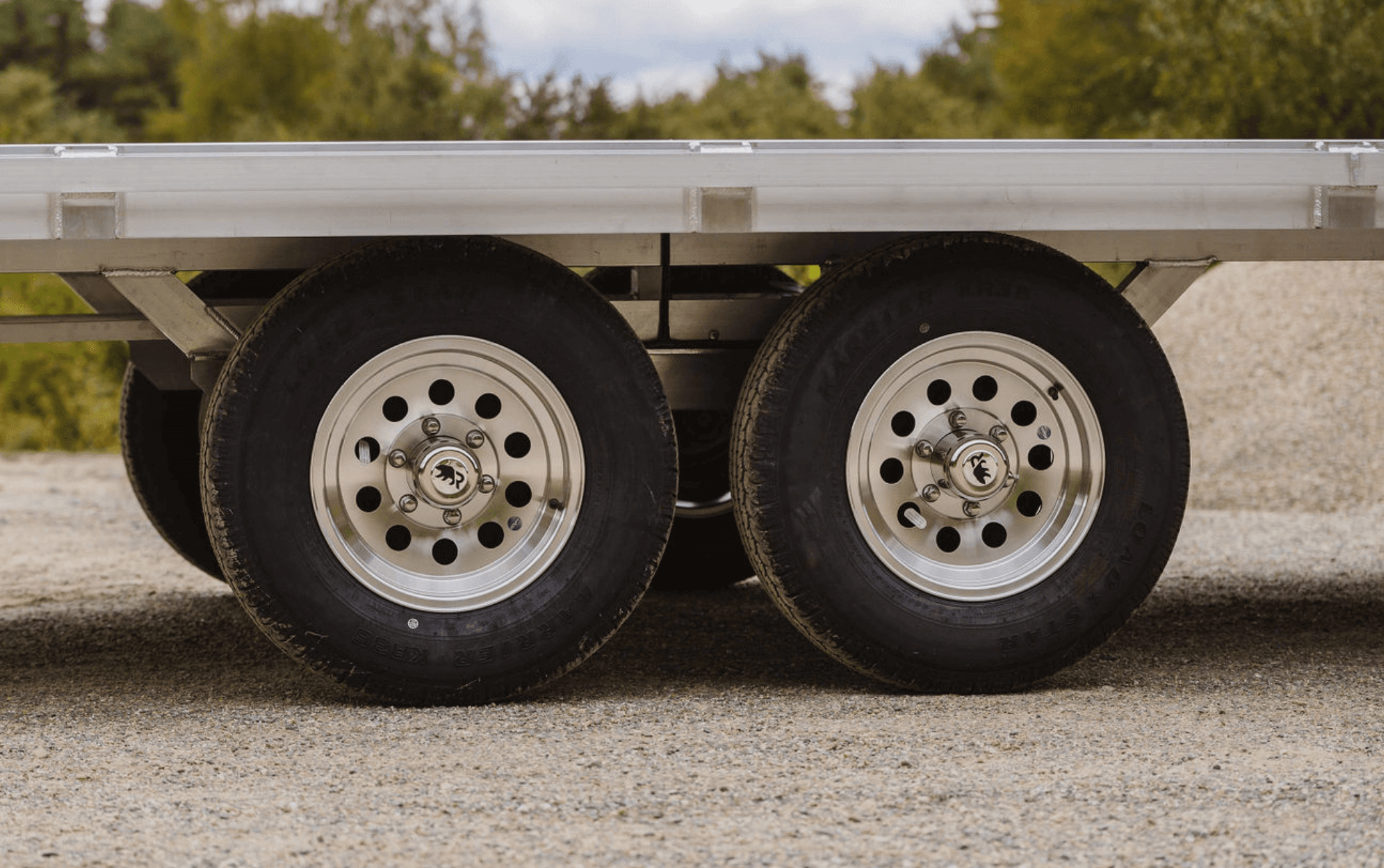
A steel trailer in a salted-road state needs paint touch-ups, undercoating, and rust remediation on a schedule — skip it and the frame pays. An aluminum structure needs a wash and standard running-gear service. Note "structure": axles, hubs, and couplers are steel on nearly every trailer, including ours, because that is the right material for those parts. They need the same greasing either way — see bearing maintenance.
Cost: up-front vs. 10-year
Steel wins the sticker comparison — often by 20–40% on comparable sizes. Our open utility line starts at $3,596. What the sticker hides is the other side of the ledger: rust remediation, repainting, and the resale cliff. Ten-year-old steel utility trailers in the Northeast routinely sell for scrap-adjacent prices; clean aluminum trailers hold a meaningful fraction of their original price because the structure is intact.
| Cost factor | Steel | Aluminum |
|---|---|---|
| Purchase price | Lower | Higher (20–40%) |
| Corrosion upkeep | Recurring (paint, coating, repair) | Wash-downs |
| Running-gear service | Same | Same |
| Fuel burden | Higher (heavier tow) | Lower |
| Resale after 10 yr | Weak in salt states | Strong if maintained |
For the full worked example with real numbers, read are aluminum trailers worth the money?
When steel is the right answer
- You need maximum load capacity per dollar and the trailer lives indoors or in a dry climate.
- The trailer will take repeated impact abuse (demolition, scrap, rental fleets) where dent-and-repair economics dominate.
- You have welding capability on site — steel field repairs are simpler and cheaper.
When aluminum is the right answer
- You live where roads are salted, or store the trailer outdoors.
- Your tow vehicle is an SUV or half-ton where trailer weight eats real capability.
- You plan to own the trailer for more than 4–5 years, or care what it is worth when you sell it.
- You want the trailer’s payload rating to go to cargo, not to the trailer itself.
- Are aluminum trailers weaker than steel?
- Per pound of material, aluminum is less strong than steel — which is why design matters more. A properly engineered tubular-extrusion aluminum frame carries its rated load for decades; the ratings on our trailers (GVWR, payload, GAWR) are the real engineering limits, not marketing.
- Do aluminum trailers crack at the welds?
- Poorly designed ones can, at stress concentrations. This is why we publish photos of our actual welds and use full tubular members at load points. Ask any builder to show you theirs.
- Why are the axles on an aluminum trailer steel?
- Because steel is the right material for axles, spindles, and couplers — high point loads, standardized service parts. "All-aluminum" refers to the structure: frame, tongue, cross members, floor.
- Does aluminum rust?
- Aluminum does not rust (rust is iron oxide), but it is corrosion-resistant, not corrosion-proof — salt exposure can pit the surface cosmetically. Structurally, it does not suffer the frame rot that ends steel trailers.